Feel free to contact us! webmaster@kungkarl.se

English summary by B.A. Anders Wesslén


A hero lives in the past as well as in the future. His life ought to be short and must contain grand achievements that will make his memory immortal. The Swedish king Charles XII (1682-1718) was a hero in this sense of the word. He lived fast and furious and was killed in Norway at the age of thirty-six by a shot in the left temple. The two kings he modelled himself on – Gustav Adolphus and Alexander the Great – both died in their thirties.


In 2005, during a panel debate in Gothenburg, a Swedish historian exclaimed: "The king’s corpse is alive!" And not without good reason. The symbolic value of Charles XII is extraordinary: still he sets strong and diverse feelings in motion, and political disputes have often been the result. Some have described him as the total abstainer, even a moral example, others commend him for the invasion of Norway in 1718; history’s first total war. Not so long ago, the Swedish extreme right used his name as a weapon against socialism, while his admirers on the left wing, in the late 20th century, went on to call him the king that introduced taxes based on income.


On November 30th 1868 a statue of Charles XII was raised in Stockholm. He was given a hero’s reception, and the bronze monument was to portray the greatest Swede who ever walked the earth. August Blanche, a liberal politician and journalist who delivered the first speech, died early in the morning, perhaps from over-excitement.


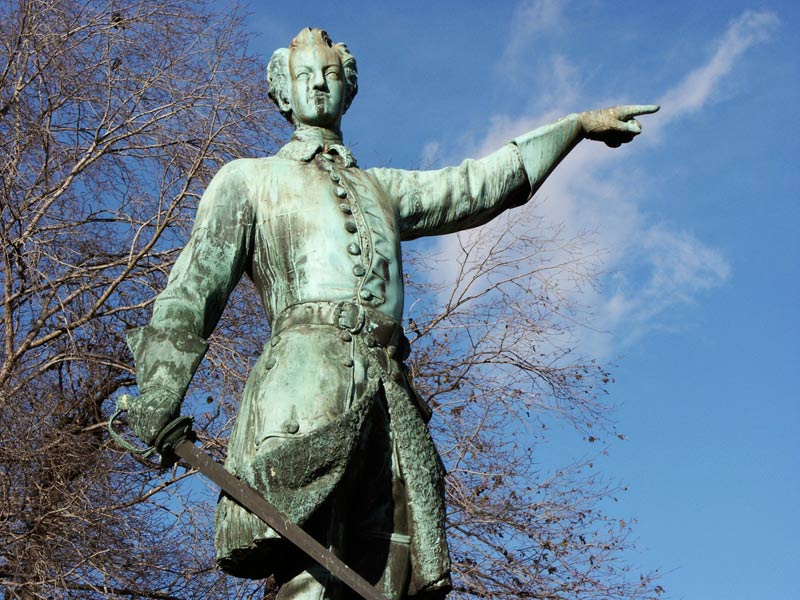
Statue of Charles XII of Sweden. Made by Johan Peter   Molin.   Kungsträdgården, Stockholm. Photo by Karl Larsson.

Statue of Charles XII of Sweden. Made by Johan Peter Molin. Raised in Kungsträdgården, Stockholm, 1868. Photo by Karl Larsson.


Recently a suggestion has been made to put a rope around the king’s neck, pull the statue down on the ground and batter it with sledgehammers. Others, that are not so violent, want to replace it with a monument in honour of the Swedish diplomat Raoul Wallenberg. We shall not honour a dictator and a slaughterer of innocent people while neglecting to recognise a man saving thousands of people from the Nazi gas chambers during World War II, one non-Socialist said. People with no expert knowledge have diagnosed the king as a psychopath with autistic features.


In October 1964 an unknown person provided the statue in Kungsträdgården with a bright red yo-yo. For several days it hung from the king’s left finger, which points towards the archenemy in the East. The joke was not lost on the Swedish press: a newspaper suggested that one should shoot down the ridiculous toy. But the shooter must be very careful, the paper warned, we do not want to repeat what happened in Norway, below the fortress of Fredriksten, and hit the king’s head.


François Voltaire’s Histoire de Charles XII was the most circulated book in France during the 18th century. Needless to say, Voltaire has very much set the agenda when it comes to the afterlife of Charles XII.


The king’s official biographer, Jöran Nordberg, did not think much of Histoire de Charles XII. "The book scarcely deserves a translation into the Swedish language", he proclaimed. In fact Nordberg called his French colleague a liar. Histoire de Charles XII fell victim of censorship (1739). It was dismissed as offensive and unskilful. The positive remarks given about Peter the Great were incompatible with the propaganda of the Swedish government: in the early 1740s the ruling party – "the Hats" – wanted to take up where Charles left off. But the new war against Russia ended with a painful and embarrassing Swedish defeat, and the name Charles XII again fell from grace.


Statue of Charles XII of Sweden.

Charles XII of Sweden. Jacques Philippe Bourchardon , 1747. Gripsholm. Photo by A. Wesslén.


The Age of Liberty ended with a coup d’état led by Gustav III in 1772. Charles XII alone had previously been given the full responsibility for the fall of the Swedish Empire. Now, a good amount of blame was given to the Swedish nobility. Gustav III was fairly impressed with his predecessor; his son on the other hand – Gustav IV – worshiped the man. Rumours circulated that he once dressed himself in Charles’ clothes, and Gustav IV also had his idol’s coffin opened (only out of curiosity and without scientific pretext).


Charles XII was generally disliked during the 19th century. Erik Gustaf Geijer, the most outstanding writer and historian of his time, blamed the king for the loss of Finland in 1809, although Charles had been dead for almost a hundred years. In the books of Anders Fryxell, the most read historian in the latter part of the century, the king is described as brutal and vindictive. Esaias Tegnér wrote his splendid poem King Charles, the young hero, it is true, but more than anything Tegnér wanted to bring people together after the kingdom was divided in 1809.


The 1860s were a light in the dark with the inauguration of the statue made by Johan Peter Molin. The disbandment of Scandinavism and a fear of Russians preceded this event.


A period characterised by bitterness followed the dissolution of the union between Norway and Sweden in 1905. Conservative forces described Sweden as the outpost of the west. "The Russian threat is more substantial than ever", claimed a professor in political science.


Swedes and Germans met in Berlin in the autumn of 1910 to negotiate about Sweden becoming a German ally in case of a war against Russia. Simultaneously, in Stockholm, an academy dedicated to Charles XII was established. The idea belonged to the historian and politician Professor Harald Hjärne, but it was his colleague, Professor Arthur Stille, that made it become a reality.


In the awakened interest for Charles XII, Arthur Stille observed promising signs of spiritual rebirth of the people of Sweden. The academy became a big success, and the members consisted of two kinds of people: leading military officers and historians who tried to influence public opinion. The new school had strongholds in Uppsala, Stockholm and Lund.


Until that time, the history of Charles XII had been written by partial historians, the new school claimed, for example Anders Fryxell and August Strindberg. Strindberg pointed out to his audience, that Charles XII was a destroyer, nothing but a butcher: the king devoted himself to plunder in two times nine years and had no visible goals other than adventure. August Strindberg threw punches at the conservative politicians and military men by dragging their hero’s name through the mud.


The new school erased these black brushstrokes and succeeded in weeding out opponents. After 1910, the old school, which condemned Charles XII, had no members left in the academic world.


The bourgeois Swedish society was severely threatened, parliamentarians were gaining ground, and when the liberal party under Karl Staaff took over government in 1911 the negotiations in Berlin ended without agreement. The Swedish right used Charles XII as an antidote to everything that smelled of labour movement and parliamentarianism and tried to stir up patriotic feelings with the help of Charles XII’s sword and leather boots.


The textbook writer Carl Grimberg supplied the Swedish school with the new and positive image of Charles XII created by Harald Hjärne and Arthur Stille. His textbook Folkskoleboken was printed in approximately two million copies. The Swedish socialists said that the history books of Carl Grimberg glorified war; they were partial and hostile toward the working class. Grimberg was put under observation.


There is no doubt that Harald Hjärne and his fellow historians had a political, hidden agenda. Their goal was a military rearmament. They anticipated that an awakened interest for the Carolean period would have a favourable influence on the public opinion. The events that followed fulfilled their hopes to some extent.


In the years preceding World War I, various Swedish commanding officers became radical and wanted to recreate the absolute state. Gustaf V of Sweden held a controversial speech before thousands of peasants in February 1914. The king distanced himself from the government and expressed his concerns over the Swedish armed forces and called for higher defence spending. After the Courtyard Crisis, Prime Minister Karl Staaff resigned in protest. Two non-parliament members had written the king’s speech: Sven Hedin, the well-known explorer, and Carl Bennedich, a military officer. Both were big admirers of Charles XII.


For Harald Hjärne, Arthur Stille and the new school, it was important to reassess the three most disputed periods in the reign of Charles XII: the Polish campaign, the Russian campaign and the king’s exile in the Ottoman Empire.


The Polish war (1701-1706) began with the Crossing of the Daugava in June 1701. It took half a decade to complete the removal of Augustus II. The provinces in the east suffered tremendously and the Tsar established the city Saint Petersburg in Ingria while the Polish campaign was being fought.


Even Frans G. Bengtsson, the author of the most popular biography on Charles XII since Voltaire, thought the dethronisation was a bad idea. Normally Frans G Bengtsson supported all the king’s decisions. The fault was not petty, he said, but magnificent!


Charles XII’s campaign against Russia (1707-09) was a difficult one, to say the least. He wanted to finish it quickly by heading directly towards the Russian capital. After the victory at Holowczyn on the 4th of July 1708, the Swedish army began to suffer. In the beginning of 1709 it had been reduced enormously in size. The extreme winter of 1708-09 had been the toughest challenge of all.


Charles never arrived in Moscow: he was forced to head south, where he allied with the Ukrainian leader, hetman Ivan Mazepa.


The summer of 1709 was a really bad one for Charles XII. Not only did he get hit by a bullet on his birthday, but also the Swedish army suffered a decisive defeat in the battle of Poltava on the 28th of June. As a result of his injury, Count Rehnskiöld was commander-in-chief during the clash. The feverish Charles XII, lying on a stretcher carried by four horses, participated as much as he could; he waved his rapier and encouraged his men. About 7 000 Swedish soldiers were killed. A couple of days later, the Infantry-General Lewenhaupt surrendered himself together with 23 000 men, women and children. Charles, on the other hand, left his army the night before and crossed the border to the Ottoman Empire.


Arthur Stille wrote a book where he explains the Russian campaign and the king’s plans. Ernst Carlson, a member of the old school, said that these plans have more to do with Arthur Stille than Charles XII.


The Swedish warrior king stayed five years in the Ottoman Empire (1709-14). He refused to go home without an escort consisting of 50 000 Turks, and he succeeded in persuading the Ottoman Sultan and his Grand Vizier to declare war on Russia. But finally, in February 1713, the Ottomans stormed the Swedish headquarter. After the hopeless struggle against thousands of Turks, Charles was imprisoned. On the 20th of September 1714 he finally began his journey back home to Sweden.


In the absence of Charles XII, Sweden’s enemies had increased in numbers since – and because of – the battle at Poltava. Not only had Augustus II retaken his Polish crown, but also the Prussians and George of Hanover (also king George I of England) had declared war against Sweden. In 1716 Sweden had no longer control over Finland, the eastern states or its German provinces.


According to the new school, Charles XII was neither a big conqueror, nor a diplomat. But the king was righteous; he was an underrated statesman and the number one fighter of Muscovites, the precursor to Germany of the early 20th century. His struggle must continue, the East European problem must be solved, the new school said.


A model of the king's head made during the examanition of Charles XII's remains 1917. Another angle. Photo by A. Wesslén.

A model of the king's head made during the examanition of Charles XII's remains 1917. Photo by A. Wesslén.


In 1917 the fourth examination of the mummified remains of Charles XII took place in Riddarholmskyrkan in Stockholm. It was a turbulent time characterized by rationing, fear of revolution, demonstrations and riots. The Swedish right, including Gustaf V, gathered around Charles’ coffin and had young soldiers parading in front of the grave chamber. Of course, the main reason was to clear up the difficulties surrounding the warrior king’s death, but the event had more than one purpose: the corpse, placed against the background of Gustavus Adolphus tomb, was to awaken patriotic feelings among the visitors.


In 1918, on the two-hundredth anniversary of the king’s death, the renaissance of Charles XII reached its peak. The new school summarised the king’s life in one book – the foreword is written by Harald Hjärne – and the Swedish general staff put together an extensive work: Charles XII on the Battlefield.


After the world war and the anniversary, again the warrior king was heavily questioned: some military men expressed critical views on Charles XII’s strategy. They solely blamed him for the loss of the Baltic states and could not forgive him for underestimating Russia (the king should have listened to his advisors). Charles XII was a hero, but a tragic one, he was noble, but at the same time obsessed with acts of retaliation. He was a warrior, and a great one at that, but a skilled statesman? The new school did its best to dismiss all these new negative judgements, which bare some likeness to the previous condemnations, mostly by giving the books and articles in question bad reviews.


Historians have continued to treat the research results made by Hjärne and his fellow historians with respect, and even today the new school has its members. Although the results were based on studies of European archives, they express conservative values and a great fear of Russia. Admiration of Charles XII and fear of foreign powers often go hand in hand.


Sources:


Hjärne, H., "Karl XII. En uppgift för svensk häfdaforskning", in Vintergatan 1897

Kuylenstierna, O., "Karl XII:s personlighet och den nyare forskningen" in Karolinska förbundets årsbok 1910

Stille, A., Konung Karl XII:s banesår, Stockholm 1918

Stille, A., Carl XII:s fälttågsplaner 1707–1709, Lund 1908

Björck, S., Karl XII:s stövlar, Stockholm 1954

Dahlgren, S; Florén, A; Lindegren, J, Kungar och krigare. Tre essäer om Karl X Gustav, Karl XI och Karl XII, Stockholm 1997

Elvander, N., Harald Hjärne och konservatismen. Konservativ idédebatt i Sverige 1865–1922, Uppsala 1961

Englund, P., "Myten om fältherren", in Förflutenhetens landskap, Stockholm 1991

From, P., Katastrofen vid Poltava. Karl XII:s ryska fälttåget 1707–1709, Lund 2007

Gunneriusson, H., Det historiska fältet. Svensk historievetenskap från 1920-talet till 1957, Stockholm 2002

Gurevich, A., Den svårfångade individen. Självsyn hos fornnordiska hjältar och medeltida lärda i Europa, Stockholm 1997

Jonasson, G., Historia kring Karl XII, Stockholm 1964

Järv, H., Strindbergsfejden, Uddevalla 1968, part I–II

Karlsson, Å., "Att ta från de rika. Karl XII:s förmögenhetsskatt 1713" in Makt och vardag. Hur man styrde, levde och tänkte under svensk stormaktstid, Stockholm 1993

Oredsson, S., "Livskraften hos Karl XII-forskningens ‘nya skola’", in Zetterberg, K., och Åselius, G., (red.), Historia, krig och statskonst, Västervik 2001

Oredsson, S., "Stormaktsdrömmar och stridsiver" in tidskriften Scandia band 59, årgång 1993, häfte 2

Oredsson, S., Svensk rädsla. Offentlig fruktan i Sverige under 1900-talets första hälft, Falun 2001

Oredsson, S., Tsar Peter och kung Karl. Två härskare och deras folk, Stockholm 1998

Rodell, M., Att gjuta en nation, Uddevalla 2002

Stenroth, I., Sveriges rötter. En nations födelse, Lund 2005

Strindberg, A., "Hästen", in Afton-Tidningen den 19 maj 1910

Torbacke, J., Carl Grimberg – ett underbart öde?, Göteborg 1993

Voltaire, F., Carl XII:s historia. Tolkning, inledning och kommentarer av Gunnar von Proschwitz, Stockholm 1997

Wästberg, P., Kungsträdgården, Uddevalla 1986

Åberg A., "Karl XII-bilden genom tiderna", i Svensson, A. (red), Karl XII som fältherre, Luleå 2001


© Anders Wesslén 2009


Alla bilder och texter på Kungkarl.se är © Kungkarl.se 2002-2008. Varken bilder eller texter på sidan får kopieras utan min skriftliga tillåtelse. Sidan är optimerad för Windows och för Internet Explorer 5.5 eller senare versioner. En upplösning av 1024 * 768 eller större rekommenderas. För mer info maila på följande adress: anders@kungkarl.se